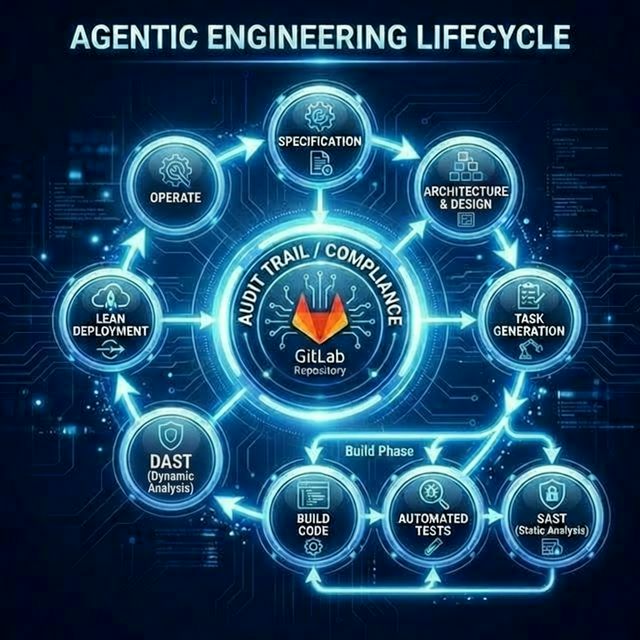
The Agentic Engineering Lifecycle
Traditional Software Development Life Cycles (SDLC) assume human engineers writing every line of code by hand. In the era of AI coding assistants and autonomous agents, the bottleneck shifts from writing code to writing specifications.
This document outlines our Specification-Led Delivery lifecycle. It acts as a hub pointing forward to how we leverage agentic tools at every phase of product development to generate, test, and review software.
(The flowchart below details the parallel task execution paths captured in the diagram above)
graph TD
    %% Core Nodes
    Spec["1. Specification (PRD)"]
    Arch["2. Architecture & Design"]
    TaskGen["3. Task Generation"]

    %% Parallel execution block
    subgraph Parallel Execution
        Build["4. Building Code<br/>(Agent Workbench)"]
        Test["5. Automated Tests"]
        SAST["6. SAST<br/>(Static Analysis)"]
    end

    Review["7. Code Review & Auditing<br/>(GitLab MR)"]
    Deploy["8. Lean Deployment<br/>(Kanban to Prod)"]
    DAST["9. DAST & Monitoring<br/>(Dynamic Analysis)"]
    Operate["10. Operate & Observability<br/>(Production)"]

    %% Center / Repository / Audit
    GitLab[("GitLab Repository<br/>(Source of Truth)")]
    Audit[("Audit Trail\n(Regulatory Compliance)")]

    style Audit fill:#f9f,stroke:#333,stroke-width:2px
    style GitLab fill:#fc6d26,stroke:#333,stroke-width:2px,color:#fff
    style Review fill:#f2f2f2,stroke:#333,stroke-width:2px

    %% Flow logic
    Spec --> Arch
    Arch --> TaskGen

    %% The Fork
    TaskGen -->|Decomposed| Build
    TaskGen -->|Decomposed| Test
    TaskGen -->|Decomposed| SAST

    %% Convergence to Review
    Build -->|MR| Review
    Test -->|MR| Review
    SAST -->|Clearance| Review

    %% Iterative Feedback Loops
    Review -.->|Logic Flaw| TaskGen
    Review -.->|Bug/Fix Required| Build
    Review -.->|Missing Coverage| Test
    Review -.->|Vulnerability Found| SAST

    %% Parallel post-review
    Review -->|Approved| Deploy
    Review -->|Approved| DAST

    %% Operate Phase
    Deploy --> Operate
    DAST --> Operate
    Operate -->|New Feature Ideas| Spec

    %% Audit & GitLab links
    Build -.-> GitLab
    Test -.-> GitLab
    SAST -.-> GitLab
    Review -.-> GitLab
    DAST -.-> GitLab
    Operate -.-> GitLab

    Spec ===>|Logs| Audit
    Arch ===>|Logs| Audit
    TaskGen ===>|Logs| Audit
    GitLab ===>|Commits/Revisions| Audit
    Deploy ===>|Release Tags| Audit
    DAST ===>|Scan Reports| Audit
    Operate ===>|Usage Metrics| Audit
1. Specification (The New “Coding”)
In an agentic workflow, the natural language specification is the source code. If the spec is vague, the generated code will be brittle.
- The Goal: Write exhaustive product requirements documents (PRDs) that leave no room for agent hallucination.
- Agentic Tools Used: Chat interfaces (ChatGPT, Claude, Gemini, Jules), requirements gathering templates.
- Deep Dive: How to Write Agent-Ready Specifications (Coming Soon)
2. Architecture & Design
Agents are excellent at scaffolding code, but they struggle with creating holistic, distributed system architectures from scratch without guidance.
- The Goal: Produce a
DESIGN.mdor architecture diagram that constrains the agent’s technology choices and structural patterns. - Agentic Tools Used: v0, Lovable (for UI prototyping), architectural prompting patterns.
- Deep Dive: Constraining Agents with Architecture Definitions (Coming Soon)
3. Incremental Task Generation & Decomposition
Instead of feeding an entire PRD to an agent and hoping for the best, the work must be broken down into discrete, testable steps. This step feeds the parallel tracks below.
- The Goal: Convert specifications into a sequential
task.mdor Epics/Tickets that an agent can execute one at a time. - Agentic Tools Used: Agentic planners (like Kiro or custom LLM task-breakdown prompts).
- Deep Dive: Breaking Down Work for Agentic Execution (Coming Soon)
4. Building Code (Parallel Track A)
This is where the actual code is manifested. Rather than writing files manually, the engineer acts as an orchestrator, reviewing the agent’s proposed changes.
- The Goal: Execute tasks rapidly via multi-file editors. Output is pushed as Merge Requests (MRs) to GitLab, which acts as our central Source of Truth.
- Agentic Tools Used: Deeply integrated IDE agents (Antigravity, Cursor Composer, Windsurf), GitHub Copilot Edits, and CLI tools (Aider, Jules).
- Deep Dive: Effective Vibe Coding: Scaffolding and Generation (Coming Soon)
5. Automated Test Generation (Parallel Track B)
Code and the tests that validate it are generated synchronously by agents. Test-Driven Development (TDD) pairs perfectly with agentic workflows.
- The Goal: Generate comprehensive unit and integration tests before or immediately after feature generation to prevent regressions. Push test cases to GitLab.
- Agentic Tools Used: Windsurf, GitHub Copilot.
- Deep Dive: Agent-Driven TDD and Test Generation (Coming Soon)
6. SAST Agent (Parallel Track C)
As soon as a task is generated, static analysis tools begin evaluating the proposed dependencies, architecture, and code snippets during the build phase.
- The Goal: A specialized SAST Agent automatically audits the work for vulnerabilities, hardcoded secrets, and compliance violations before it can be merged.
- Agentic Tools Used: GitLab CI/CD, LLM Security Scanners.
- Deep Dive: Securing and Validating Agentic Code in CI/CD (Coming Soon)
7. Code Review & Auditing (Convergence Loop)
The parallel tracks converge back together in a GitLab Merge Request. When code is generated at high speed, traditional line-by-line review processes break down. The focus shifts to reviewing the behavior and the security of the generated output. If any track fails, an iterative feedback loop automatically kicks the code back to Step 3, 4, 5, or 6.
- The Goal: Ensure AI-generated code meets non-functional requirements (security, performance, maintainability) before merge.
- Agentic Tools Used: Automated MR assistants (GitLab Duo).
- Deep Dive: Performing Code Reviews on AI-Generated Code (Coming Soon)
8. Lean Deployment (Kanban to Production)
We prioritize continuous delivery of validated, bite-sized tasks over massive sprint-cycle releases.
- The Goal: Utilize a Lean, Kanban-style flow where tickets move from Specification directly through to Production the moment they clear the Code Review and pipeline. This ensures AI-generated features are shipped iteratively and incrementally, drastically reducing integration risk and time-to-market.
- Deep Dive: Lean Deployments in an Agentic Workflow (Coming Soon)
9. DAST (Post-Deployment Monitoring)
After the code is deployed to a live environment, Dynamic Application Security Testing (DAST) agents simulate real-world attacks.
- The Goal: Continuously monitor the running application for exploitable vulnerabilities that static analysis might have missed. If a vulnerability is found, it automatically generates a new task in the backlog.
- Agentic Tools Used: Automated DAST scanners, Attack Simulation Agents.
- Deep Dive: Continuous Monitoring and DAST (Coming Soon)
10. Operate & Observability (Production)
Once code is safely deployed and continuously scanned, the system enters the long-term Operate phase.
- The Goal: Measure application performance and gather user usage metrics to feed new ideas back into the Specification phase. Agentic observability tools analyze log data to uncover scaling bottlenecks and preemptively draft new feature or refactor specifications.
- Agentic Tools Used: AI-Assisted APM tools (Datadog Watchdog, New Relic AI).
- Deep Dive: AI Observability and Operations (Coming Soon)